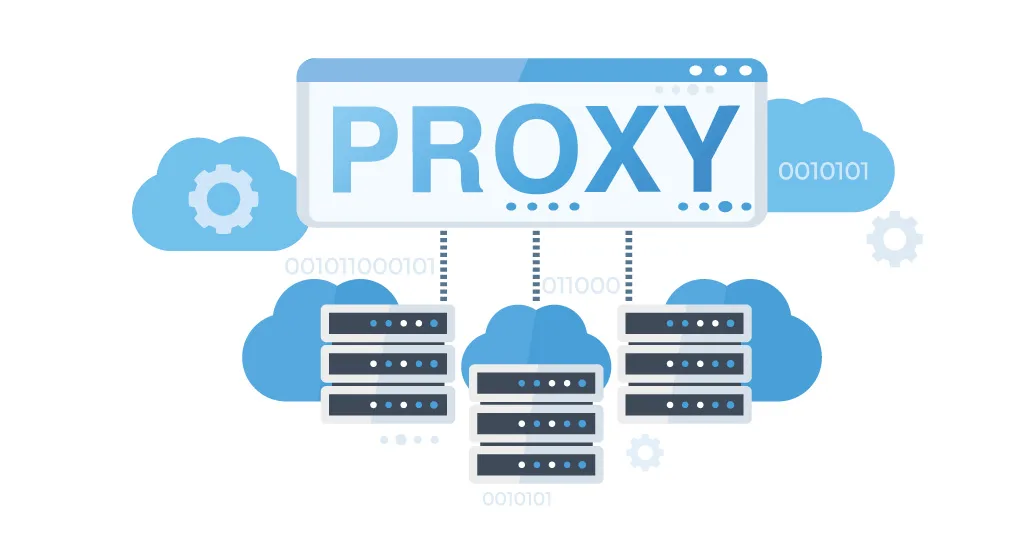
What Is a Proxy? Definition and How a Proxy Works
A proxy is a system that mediates between the user and the internet to hide the user's real identity, so that data sent to the destination website uses the IP address of the proxy server instead of the user's IP address.
To do its job, a proxy needs a server, called a proxy server. A proxy server is a network service that provides proxy services, which can be a particular device or computer, and functions to process requests using the proxy.
The user's identity and IP address are hidden by the proxy. In practice, proxies are widely used by people who want to visit sites that are blocked in certain regions. Many companies and businesses also use proxies to create closed business networks.
So far, you have understood what a proxy is. Next, after explaining the definition of a proxy, we will explain how a proxy works.
How a Proxy Works
A proxy server is usually located between the local computer and the internet. Without a proxy server, information from your computer is first forwarded through the internet service provider (ISP) router, and then forwarded to the server of the site you want to visit.
So, when you access a website, your request is sent to the proxy server for processing. The request, with its data modified, is then forwarded to the destination website. That way, the website sees the IP address of the proxy server, not your IP address.
A proxy is actually similar to a VPN. The difference between a proxy and a VPN is that a VPN secures all network traffic, whereas a proxy works per application only. Both hide your IP address, but a VPN routes internet data through an encrypted tunnel. A proxy is suitable for browsing the internet, but using a VPN is still safer.
Even so, this is not the only benefit we can get from it. There are several additional protections we can obtain, depending on the type of proxy, each of which has a specific function.
Types of Proxies
Although they have the same function, there are several types of proxies whose working systems differ.
In general, the following are 4 widely used types of proxies:
1. Anonymous Proxy
An anonymous proxy is a type of proxy that hides the IP address of the user's device from the website, and can also enable encryption on the user's side. That way, the user's personal data remains protected and secure.
2. Distorting Proxy
A distorting proxy has a function almost the same as an anonymous proxy, but works differently. A distorting proxy forwards your connection to the internet, but uses a fake IP address.
That way, you can access different locations to open websites blocked by the government.
3. High Anonymity Proxy
A high anonymity proxy works by periodically randomizing the IP address connected to the internet, so the user's real IP address is very hard for anyone to trace. In fact, the destination server cannot detect that the connection was made through a proxy.
4. Transparent Proxy
A transparent proxy is an intermediary system between the user and the content provider. So, when a user makes a request to a web server, this type mediates the request to do several things, including caching, redirection, and authentication.
Usually, some institutions use this proxy for content restriction or filtering.
Advantages of Proxies and Their Functions
A proxy has several main functions that are useful for its users.
The following are the functions of a proxy in internet use:
1. Controlling Children's Internet Use
To keep children's internet use safer, parents can restrict their children's internet access by using a proxy server to access only certain websites through their devices. That way, children can be better controlled so that they do not access harmful sites.
2. Reducing Bandwidth Load
Users can get better bandwidth and internet connections by using a proxy server. A proxy server can also be used for web cache storage, that is, to store local copies of websites, especially frequently visited ones.
3. Providing Additional Protection
Both individuals and organizations can use a proxy server for a more secure connection when browsing the internet.
Of course, for any company or institution, a system that guarantees data security is essential so that sensitive data does not leak to competitors or other countries.
4. Accessing Blocked Websites
A proxy server can also be used to open websites blocked by the government. This is because, as explained, requests sent through a proxy pass through the proxy server and not the ISP's server, which may be controlled by the government.
Disadvantages of Proxies and Usage Problems
Despite its many benefits, you still need to be careful when using a proxy. Yes, using a proxy can still carry some risks.
The following are the disadvantages of a proxy server:
1. Does Not Fully Protect Against Cyber Attacks
Although you can access the internet more safely using a proxy server, do not trust its security 100%.
The problem is that many proxy servers still do not use encryption. As a result, your personal data can still leak if hackers use more sophisticated hacking techniques.
2. Free Proxies Are Quite Risky
Free proxies usually do not use advanced hardware or back-end encryption. You may encounter performance and data security problems. If you ever find a proxy server that truly offers a “free” service, avoid it and do not use it whenever possible.
3. Easily Tracked and Infiltrated
Because it acts as a bridge between the user and the internet, a proxy server stores a great deal of data, including users' personal information. If hackers manage to infiltrate this server, they can certainly obtain all of your sensitive information.
4. Proxies Monitor Your Internet Activity
Often, a proxy stores user data while connected to the internet. So, your data remains at risk of being monitored by hackers, or stolen and misused by irresponsible parties.
That is more or less the explanation of Proxies. Let's get to know our study program better Bachelor of Telecommunication Engineering and visit the official website Telkom University Jakarta Campus yes!
Written by Dzul Rahman
