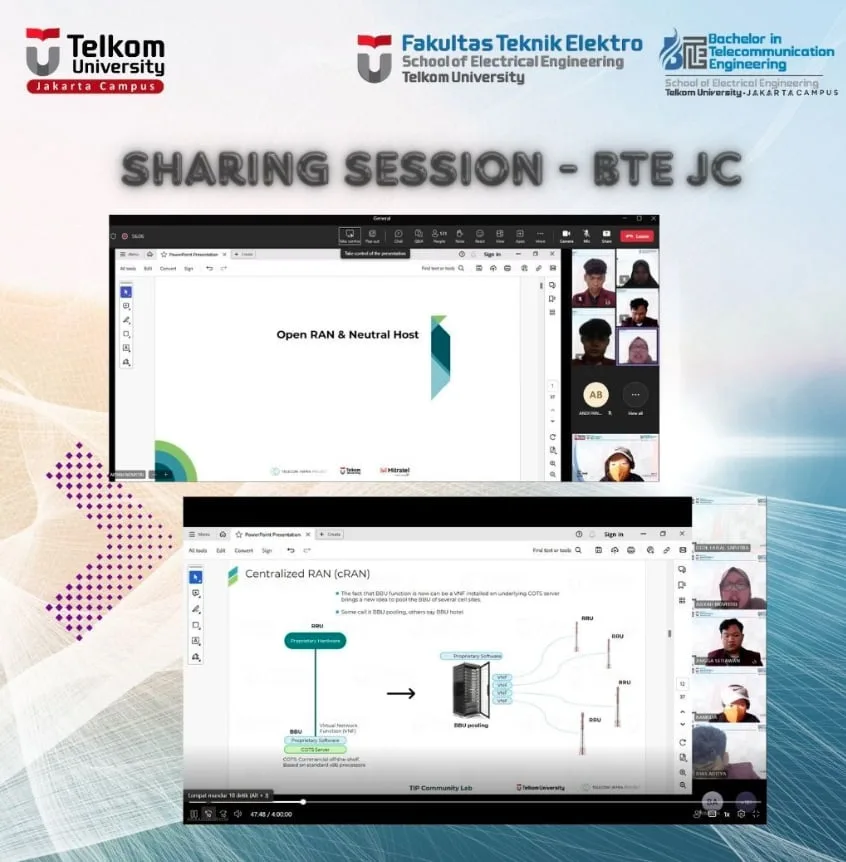
SHARING SESSION BTE-JC v.5
Introduction to OPEN RAN Technology
Sharing Session BTE-JC is a study program event held regularly by the S1 Telecommunication Engineering Study Program of Telkom University Jakarta Campus to enhance the academic atmosphere within the program. This event is MANDATORY for all members of the S1 Telecommunication Engineering academic community at Telkom University Jakarta Campus, both lecturers and students. Sharing Session BTE-JC v.5, the episode “with Bu Aisyah”, held on 14 October 2023, had the theme “Introduction to Open RAN Technology” with speaker Ms. Aisyah Novfitri, S.T., M.T., a Lecturer in the S1 Telecommunication Engineering program at Telkom University Jakarta Campus.
The presentation explained that cellular network technology has developed with every decade, from 2G – 1990, 3G – 2000, 4G – 2010, and 5G – 2020. Among these four cellular technologies, the RAN (Radio Access Network) plays an important role because it is closest to the users, widely dispersed in location, most numerous its number. The evolution of RAN from traditional RAN and Virtual RAN to Open RAN is a form of efficiency in Multi Vendor that utilizes Hardware and software disaggregation Open interfaces. This also provides technical advantages in the form of Disaggregation, Virtualization, Open Interface, Automation and Programmability.
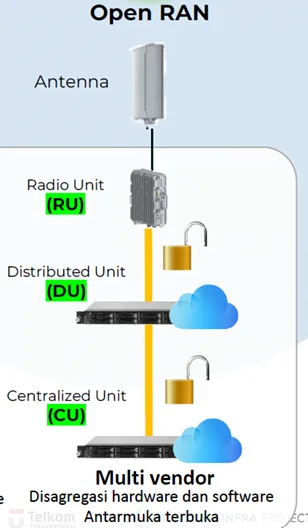
OPEN RAN Devices
The Open RAN concept consists of:
- Radio unit (RU): usually part of the antenna, the RU is where radio frequencies are transmitted and managed.
- Distributed unit (DU): the computing part inside the base station, usually located close to the RU.
- Centralized unit (CU): the computing part inside the base station, usually located close to the core.
- Fronthaul: the open interface between the RU and DU.
- Midhaul: the open interface between the DU and CU.
- Backhaul: the open interface between the CU and the core.
- RAN intelligent controller (RIC): a customizable controller used to program and add programmability to other areas of the RAN.
Advantages of OPEN RAN
Open RAN has several advantages:
1. Lower Operator Expenditure
2. Open RAN implementation time is much shorter with virtual RAN
3. Easy device upgrades because there is no dependency between vendors
4. Minimal Vendor Lock-In Risk: Open RAN systems minimize the risk of vendor lock-in
5. Easily Measurable Capacity
6. Ability to add capacity at a large scale
Open RAN is a win-win solution for everyone – network operators benefit from lower costs and the ability to bring new services to market faster, while users have access to new services when they need them and to smoother-operating networks.
Thank you for the presentation in the BTE Sharing Session, and thank you also to the committee and participants for taking part in this webinar.
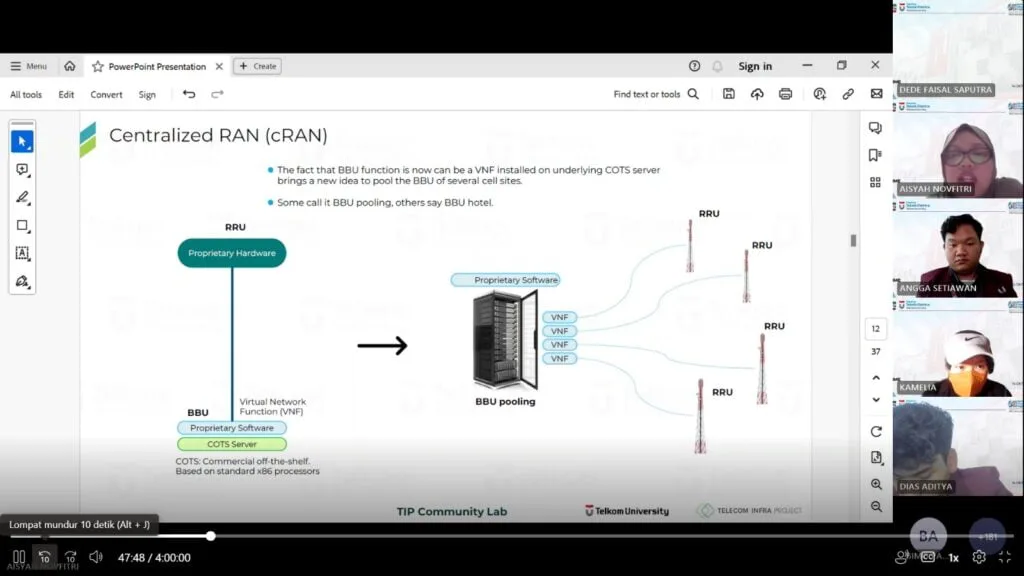

See ya next sharing session
Let's get to know the study program better Bachelor of Telecommunication Engineering and visit the official website Telkom University Jakarta Campus yes!
#telkomuniversity
#telkomjakarta
#telkomuniversityjakarta
#telutizen
#fakultasteknikelektro
#s1telekomunikasikampusjakarta
