6G Technology
6G (sixth-generation)
6G technology refers to sixth-generation wireless communication technology, which is expected to replace 5G. Although 5G is still being deployed in many parts of the world, researchers and industry experts are already looking at the potential capabilities and features of 6G. It is expected to be the next-generation wireless technology after 5G, with faster speeds, lower latency, and more advanced capabilities. It is expected to leverage technologies such as terahertz frequencies, advanced antenna systems, AI-based networks, and more to enable innovative applications such as holographic communication, seamless XR experiences, and ultra-reliable low-latency communication for critical applications such as autonomous vehicles and remote surgery.
source: https://www.ericsson.com/
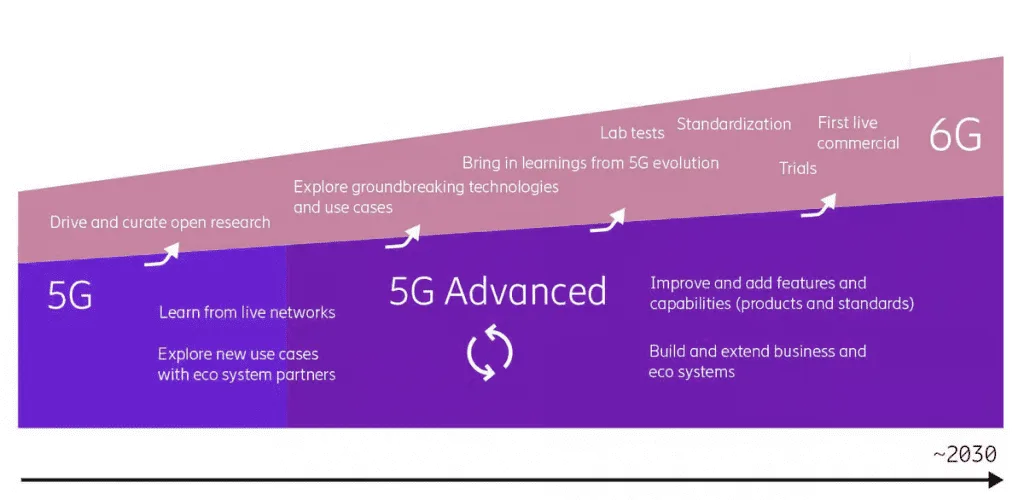
6G will not only leverage the power of 5G, but will also provide entirely new technological solutions. Around 2030 is a reasonable timeframe to expect the emergence of the first 6G networks. The evolution of 5G New Radio (NR) and 5G Core (5GC) continues in 3GPP toward 5G Advanced, to ensure the success of 5G systems globally and to expand the use of 3GPP technology by supporting various use cases and verticals. AI/ML will play an important role in 5G Advanced systems, alongside other technology components, to provide support for extended reality (XR) devices, reduced capability (RedCap) devices, and network energy efficiency.
The following are some key aspects and anticipated features of 6G technology:
-Higher Data Speeds: 6G aims to achieve faster data speeds than 5G. This means speeds measured in terabits per second, enabling ultra-high-definition video streaming, massive IoT deployments, and instant downloads.
-Lower Latency: One of the goals of 6G is to reduce latency even further than 5G. This will enable near real-time communication for applications such as remote surgery, autonomous vehicles, and immersive virtual reality.
-Advanced Spectrum Use: 6G is expected to use higher frequency bands, including terahertz frequencies. These frequencies offer wider bandwidth and faster data speeds but present technical challenges that need to be overcome.
-AI Integration: Artificial intelligence (AI) will likely play an important role in 6G networks, optimizing resource allocation, managing network traffic, and enabling intelligent connectivity. AI can also improve security and privacy in 6G systems.
-Sustainability and Energy Efficiency: With a growing focus on environmental sustainability, 6G is expected to prioritize energy efficiency and sustainable practices in network design and operation.
-Ultra-Reliable Communication: 6G networks are expected to offer highly reliable communication, enabling critical applications such as industrial automation, remote monitoring, and emergency services.
-Holographic Communication and Extended Reality (XR): 6G could enable immersive holographic communication and extended reality experiences, blurring the line between the physical and virtual worlds.
-Global Connectivity and Coverage: Efforts may be made to ensure broader global connectivity, including in remote and rural areas, through innovative deployment strategies and satellite-based solutions.
#telkomjakarta
#telkomuniversityjakarta
#s1telekomunikasikampusjakarta
