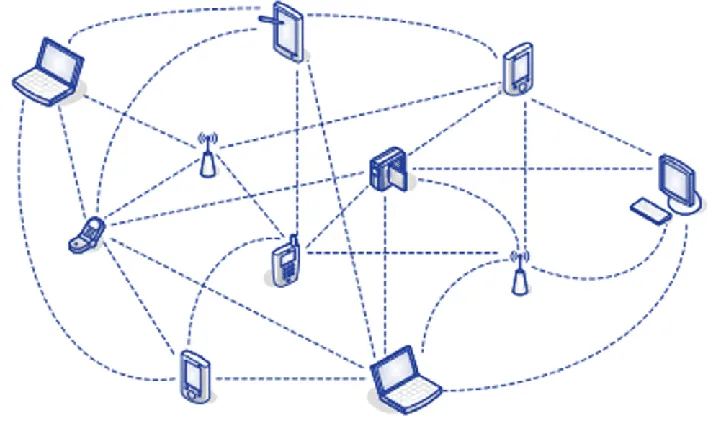
What Is a Mobile AdHoc Network (MANET)?
Mobile Adhoc Network, more often called MANET, is a wireless ad hoc network consisting of several mobile devices connected to form a network as needed. A MANET is formed without the support of existing internet infrastructure or other types of fixed stations.
The network topology of a Mobile AdHoc Network (MANET) can change dynamically and unpredictably because nodes or devices move freely. Each node acts like a router when forwarding traffic to other nodes specified in the network.
In a MANET, because the transmit power of each node is limited, every node only has access to nearby nodes. A MANET can operate independently or can be part of a larger internet. A MANET forms a highly dynamic autonomous topology with the presence of one or several different transceivers between nodes.
The main challenge of MANET networks is equipping each device so that it always has the necessary information and forwards network traffic correctly. A MANET consists of peer-to-peer networks that grow and repair themselves.
Mobile AdHoc Networks (MANET) used between 2000 and 2015 typically have a radio frequency of (30MHz-5GHz). These networks can be used in road safety, from environmental, home, and health sensors to disaster rescue operations, air/land/sea defense, weapons, robots, and more.
Characteristics of Mobile AdHoc Networks (MANET)
1. Dynamic network topology
The topology in a MANET is often multihop. The topology can also change randomly and rapidly over time, and can form unidirectional or bidirectional links.
2. Limited bandwidth
Because it uses a wireless network, the bandwidth in a MANET is limited. This is because wireless network links usually have lower reliability, efficiency, stability, and capacity than wired networks.
3. Autonomous behavior
Each node can act as both a host and a router, which shows its autonomous behavior.
4. Energy efficiency
A MANET consists of nodes or devices that depend heavily on battery power, so a MANET usually also has lightweight features that consume less memory and power.
5. Limited security
Wireless networks are more vulnerable to security threats. A MANET has no centralized firewall because routing, host configuration, and security processing are decentralized at the same time.
6. Little human intervention
Network configuration in a MANET does not require much human intervention. Therefore, a MANET is autonomous and dynamic.
Functions and Uses of Mobile AdHoc Networks (MANET)
Military defense support: Many defense applications require real-time communication facilities, and ad hoc/sensor networks are excellent candidates for battlefield management.
Crisis management applications: MANETs are very useful for quickly restoring connectivity in areas where network infrastructure has been hit by natural disasters.
Telemedicine: Paramedics assisting road accident victims in remote areas need access to patient records (for example, X-rays) and need video conference support from surgeons for emergency response. In fact, paramedics may need to immediately send the victim's X-rays and other diagnostic test results from the accident site to the hospital. For such cases, a MANET can be used.
Education via the internet: MANET technology can be used to provide education in remote areas where it is very expensive to provide long-distance wired internet access.
Advantages of Mobile AdHoc Networks (MANET)
- Independent of central network administration.
- Each node can play both roles, router and host, and is autonomous.
- Nodes can configure themselves without much human intervention.
- Highly scalable and easy to expand the network
Disadvantages of Mobile AdHoc Networks (MANET)
- Limited resources and various constraints such as noise, interference conditions, and so on.
- More vulnerable to attacks because of limited physical security.
- Latency in MANETs is quite high
Here is an explanation of what a Mobile AdHoc Network (MANET) is. Get to know our study program better Bachelor of Telecommunication Engineering and visit the official website Telkom University Jakarta Campus yes!
