Getting to Know Wireless Mesh Networks
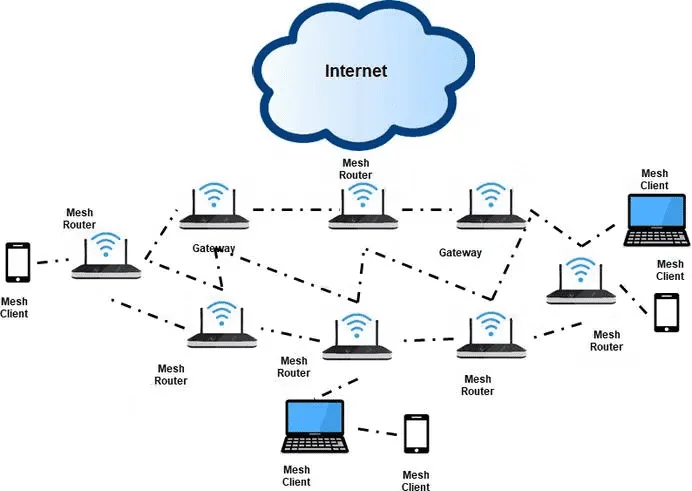
A Wireless Mesh Network (WMN) is a wireless network with a mesh topology. Each node in the network has the task of looking after the other nodes, whether sending data or receiving data through the base station. This means that every node works together to complete its task, and even if one node cannot work, another idle node can take over the communication process by organizing and configuring itself. Characteristics.
WMN coverage is not limited by connections to a base station, because nodes not covered by the base station are covered by nodes connected directly to the base station, called gateways. A wireless mesh network is integrated with the Internet, cellular networks, IEEE 802.11, IEEE 802.15, and IEEE 802.16 networks, and wireless sensor networks
The functions available in a WMN are an added value compared with conventional WLAN networks. In a mesh network, self-healing algorithms are used to support consistent routing mechanisms when a path is broken or blocked.
Wireless Mesh Network Architecture
The wireless network architecture consists of 3 main elements: infrastructure WMN, client WMN, and hybrid WMN. The infrastructure WMN is fixed because mesh routers are not designed to move.
- There are two types of nodes in an infrastructure WMN: Mesh Routers and Mesh Clients. Mesh routers act as gateways and routers to perform the routing process. Mesh clients have the same function as routers, but can also act as clients to extend the service range.
- A client WMN is a WMN architecture in which clients are connected to each other in a peer-to-peer network with router functions, because the client WMN model has no mesh routers owing to its high mobility.
- A hybrid WMN is a WMN architecture that combines infrastructure WMN and client WMN. It is usually implemented in WiMAX, cellular, and WiFi networks, based on client-to-client routing features that can improve performance and coverage in a WMN.
Characteristics of Wireless Mesh Network
The characteristics of WMN consist of:
- Multi-hop wireless network. The main goal of WMN development is to extend the coverage area on the same channel without sacrificing channel capacity.
- Supports ad hoc networks and has self-learning, self-healing, and self-configuration capabilities. WMN is expected to improve network performance through flexible, easy-to-deploy, and configurable network architecture elements that are fault-tolerant and support network connectivity.
- Supports mobile client devices with a web-form network
- Supports all types of network connections.
- WMN requires more efficient use of power supplies for some types of networks with special requirements and is equipped with sensors
- WMN compatibility in implementation can be combined with other wireless networks such as WiMAX, ZigBee, etc.
WMN Implementation
WMNs are widely implemented indoors or outdoors in their research and development, whether as cellular networks, ad hoc networks, wireless sensor networks, and others. WMNs are generally implemented in the following forms:
- SOHO (small office home office): the network connection in a SOHO relies on a broadband network using the IEEE 802.11 WLAN standard to extend the reach of the internet network. With WMN, the internet network in a SOHO can be extended so that every corner of a room in a building can access the internet while minimizing blank spots
- WMN can be implemented in a residential community or village that has internet access from DSL
- Enterprise networks can implement WMN with high scalability between buildings that have requirements for devices connected to the network, so it can reduce the maintenance costs incurred if there is a failure
- WMN can be combined with MANs that require city-wide coverage because of its scalability, which can be expanded
- Transportation systems
- Medical and healthcare computing systems
- Public security and surveillance systems
Critical Factors of WMN Network Performance
- WMN has critical factors that affect network performance, consisting of:
- Radio techniques play a significant role in implementing WMNs and affect network performance. Currently, several approaches are used to optimize the capacity and flexibility of wireless networks. One of them is the use of MIMO and multi-channel systems.
- WMN scalability emphasizes multi-hop communication. As a computer network's connectivity grows, network performance degrades significantly.
- Mesh Connectivity. WMN benefits from mesh-shaped network connectivity in terms of the MAC layer and routing protocols. Self-organization and topology control algorithms are required here.
- QoS and Broadband
- Security
Here is an explanation of Wireless Mesh Networks. Get to know our study program better Bachelor of Telecommunication Engineering and visit the official website Telkom University Jakarta Campus yes!
Written by Dzul Rahman
