Fiber Optic Communication Systems
An optical fiber is a thin, flexible, transparent fiber that acts as a waveguide to transmit light between the two ends of the fiber, enabling transmission over longer distances and at higher bandwidth (data rate) than other forms of communication. Fibers are used in place of metal cables. Signals traveling in fibers suffer less loss and are also immune to electromagnetic interference.
Evolution of Optical Fiber Systems
Generation first
The first generation of lightwave systems used GaAs semiconductor lasers with an operating region of around 0.8 microns. Other specifications of this generation are as follows:
- Bit rate: 45 Mbps
- Repeater spacing: 10 km
Second generation
- Bit rate: 100 Mbps to 1.7 Gbps
- Repeater spacing: 50 km
- Operating wavelength: 1.3 m
- Semiconductor: InGaAsP
Generation third
- Bit rate: 10 Gbps
- Repeater spacing: 100 km Operating wavelength: 1.55 m
Generation fourth
The fourth generation uses WDM techniques.
- Bit rate: 10 Tbps
- Repeater spacing: > 10,000 km
- Operating wavelength: 1.45 to 1.62 m
Generation fifth
The fifth generation uses Raman amplification and optical solitons.
- Bit rate: 40 – 160 Gbps
- Repeater spacing: 24,000 km – 35,000 km
- Operating wavelength: 1.53 to 1.57 m
Fiber Optic Components
A communication system is certainly not supported by just one or two components or devices. Inside it there must be a great many combinations of components working together. This combination and cooperation produces many benefits for the transfer of information. Thus, a communication system.
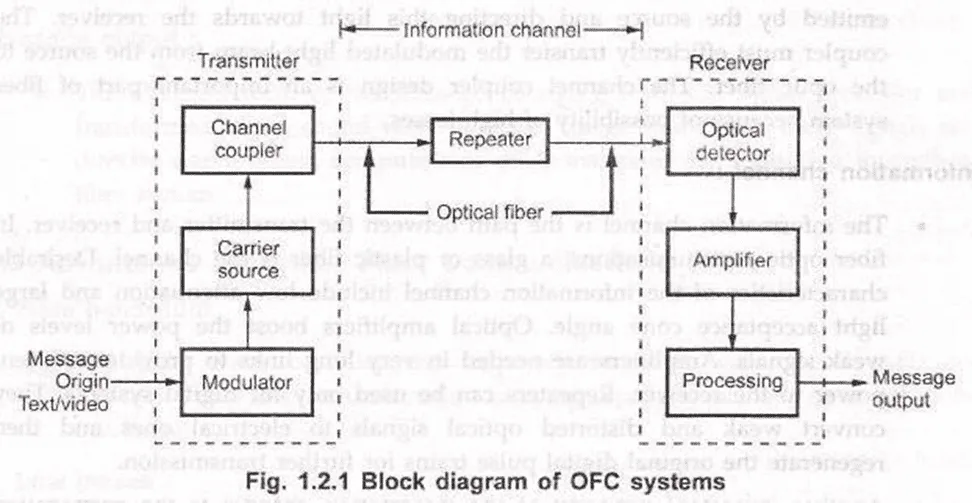
Inside it there is a modulation process so that the actual information signals can be carried through the air. Upon arrival at the destination, a demodulation process takes place to recover the original information. If it travels over a long distance, a signal amplifier is definitely needed.
The communication process in a fiber optic system is the same as in other communication systems. The five main components in a fiber optic communication system are as follows:
1. Light as the Information Carrier
This is the origin of the fiber optic communication system. Light, a natural component with many advantages, is used so cleverly to carry data at very high speed and bandwidth. All of light's advantages seem to be exploited here. Light that is fast, light that is immune to interference, light that can travel far: you will experience all of it using this fiber optic medium.
2. Optical Transmitter
The optical transmitter is a component tasked with sending light signals into the carrier medium. In this component, analog or digital electronic signals are converted into light signals. This signal then serves as the corresponding signal for your data. Physically, the optical transmitter is very close to the fiber optic medium in use. The optical transmitter is even equipped with a lens that focuses the light into the fiber optic medium. The light source of this component can vary.
The light source usually used is Light Emitting Diode (LED) or a solid state laser diode. Light sources using LEDs consume less power than lasers. However, as a consequence, the light emitted by LEDs cannot travel as far as that of lasers.
3. Fiber Optic Cable
This component is the main player in the system. A fiber optic cable usually consists of one or more optical fibers tasked with guiding the light from its origin to its destination. Fiber optic cables are constructed almost like electrical cables, with only a little added protection to safeguard light transmission. Fiber optic cables can usually be spliced, but through a very complicated process. This cable joining process is often called splicing.
4. Optical Regenerator / Amplifier / Repeater
An optical regenerator, or light signal amplifier in Indonesian, is actually a component that is not needed when you use fiber optic media over short distances only.
The light signal you send will only degrade over roughly 1 km. Therefore, if you are working over long distances, this component becomes a main component as well. An optical regenerator is usually connected in the middle of the fiber optic medium to further strengthen weak signals.
5. Optical Receiver
The optical receiver is tasked with capturing all the light sent by the optical transmitter. After the light is captured from the fiber optic medium, the signal is decoded into digital signals, which are none other than the information sent. After decoding, the digital electrical signal is sent to its processing system, such as a television, computer, telephone, and many other digital devices. The optical receiver is usually a light sensor such as a photocell or photodiode that is very sensitive to changes in light.
Fiber Optic Cable
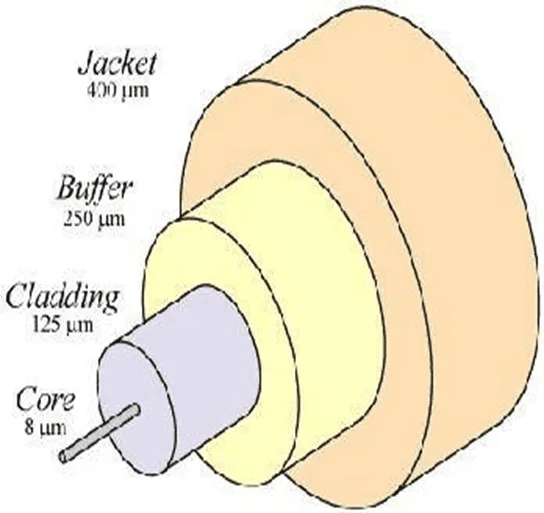
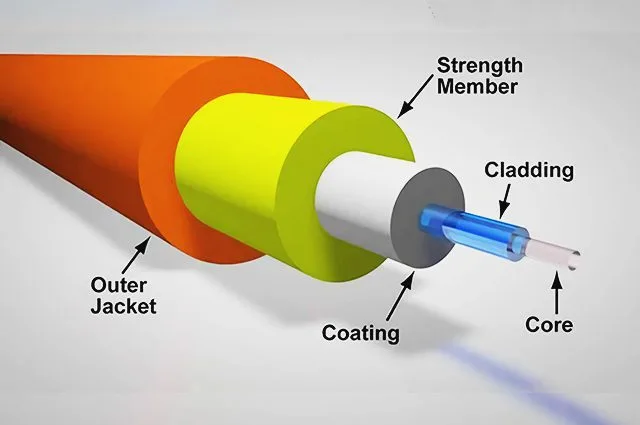
Core of a fiber cable is a plastic cylinder that runs the length of the fiber cable and is protected by a sheath. The diameter of the core depends on the application used.
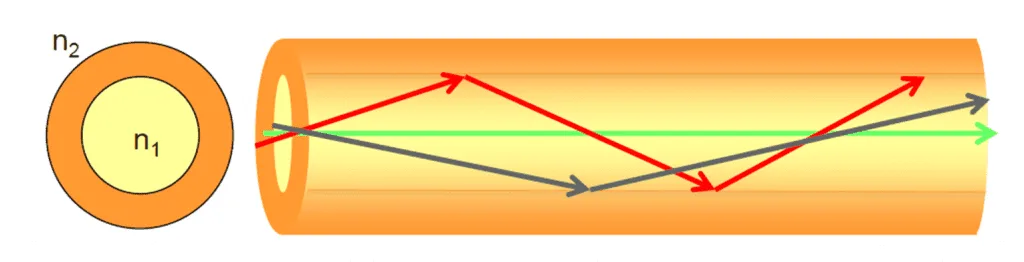
Cladding (Cladding) is the outer optical material that protects the core. The main function of the cladding is to reflect light back into the core. When light passes from the core (denser material) into the cladding (less dense material), it changes its angle and then reflects back into the core.
Buffer (Buffer) is to protect the fibers from damage, and thousands of optical fibers are arranged in hundreds of optical cables. The bundle is protected by an outer cable cover called a jacket
Jacket fiber optic cable jackets come in various colors that make it easy for us to recognize exactly what type of cable we are dealing with. Yellow clearly indicates single-mode cable, and orange indicates multimode.
Fiber Characteristics
- Wider band width: The optical carrier frequency is in the range of 10^13 Hz to 10^15 Hz.
- Low transmission loss: Fiber has a transmission loss of 0.002 dB/km.
- Dielectric wave guide: Optical fiber is made of silica, which is an electrical insulator. Therefore, it is not disturbed by electromagnetic waves or high-current lightning.
- Signal security: Signals transmitted through fiber do not radiate outward. Furthermore, signals cannot be tapped from the fiber in an easy way.
- Small fiber size and weight: Fiber optic cables are developed with a small radius, and are flexible, compact, and lightweight. Fiber cables can be bent or twisted without damage.
Disadvantages of Optical Fiber
- High investment cost
- Need for more expensive optical transmitters and receivers
- More difficult and expensive to splice than cable
- Price
- Fragility
- Affected by chemicals
- Requires special expertise
Well, that is the Optical Fiber Communication System that you will study in Telecommunication Engineering. Let's get to know our study program better Bachelor of Telecommunication Engineering and visit the official website Telkom University Jakarta Campus yes!
Written by Dzul Rahman
