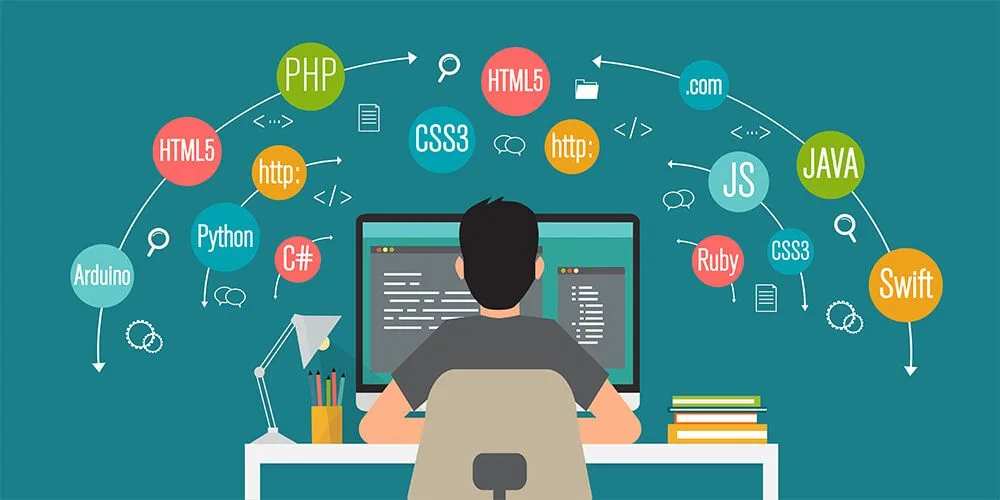
The Development of Programming Languages
A programming language is a standard set of instructions for commanding computersThis programming language is a set of rules of syntax and semantics used to define computer programs.
This language allows a programmer to specify exactly what data a computer will process, how that data will be stored or forwarded, and exactly what type of steps will be taken in various situations.
According to how close they are to the computer machine, programming languages consist of:
- Machine Language, which gives commands to the computer using binary code, for example 01100101100110
- Low-Level Language, also known as assembly language (in English Assembly), which gives commands to the computer using short codes ( mnemonic), for example MOV, SUB, CMP, JMP, JGE, JL, LOOP, etc.
- Mid-Level Language, which is a computer language that uses a mixture of instructions in human-language words (see the High-Level Language examples below) and symbolic instructions, for example {, }, ?, <<, >>, &&, ||, etc.
- High-Level Language, which is a computer language that uses instructions derived from elements of human language, for example begin, end, if, for, while, and, or, etc.
Most programming languages are classified as High-Level Languages; only C is classified as a Mid-Level Language and Assembly as a Low-Level Language.
To carry out tasks, a computer is commanded by a system. The computer's basic commands are stored in a system called an operating system, such as DOS, Unix, Windows, Linux, Solaris etc. These commands of course use machine language, in which the computer only recognizes the numbers 1 and 0 (binary), where 1 is represented as a container that has electricity and 0 has no electricity (voltage).
To build a system on a computer, a tool is needed, which we call a programming language. So what comes to mind now is: “A tool made to create programs (systems) is called a programming language”. Programs such as Macro/Turbo Assembly, Turbo C, Microsoft Visual C++, C++ Builder, Microsoft Visual Basic, Delphi, etc. are used to create applications, not as applications for processing data like Microsoft Excel, SPSS, etc. Or it can also be said that a programming language is a language used on computers to perform certain tasks. Just like the languages humans use in general, there are many types of programming languages.
Programming languages can be grouped by level, such as low-level languages, mid-level languages, and high-level languages.
The Development of Programming Languages
The creation of programming languages goes hand in hand with the history of machines and computers. The beginning of programming languages started from the Antikythera from ancient Greece. Antikythera is a calculator that uses several levers and configurations to operate. In the 1200s, Ismail Al-Jazari, a scientist during the golden age of Islam, built a machine called Automata, a peacock robot that moved using hydropower (flowing water).
The precursor of programming languages first appeared in 1822, when a machine called the Difference Engine was created by Charles Babbage, a student at the University of Cambridge, England. However, Babbage's machine could only produce one type of output. Ten years later, Charles Babbage developed the data processing machine to its second version in 1849. Babbage's struggle was continued by his son, Henry Prevost. Prevost made copies of his machine's algorithm calculations and sent them to various institutions around the world.
With the spread of Prevost's machine algorithm, development accelerated. In 1854, George Boole discovered a logic system called Boolean logic. This logic expresses the relations greater than, less than, equal to, and not equal to.
The development of this logic continued year after year until a German scientist named Konrad Zuse built a binary calculator machine called the Z-1 in 1935. Then in 1939, Zuse was called to serve in the military by building the Z-2, followed by the Z-3 and Z-4.
While developing the Z-4, Zuse realized that programming in machine language was too complicated. Machine language is classified as a low-level language because it is only a collection of 0 and 1 codes, or yes and no. After a year of research, in 1945 the world's first high-level programming language was created, Plankalkul (Plan Calculus). With Plankalkul, it was proven possible to create the world's first computer chess machine.
Short Code was proposed in 1949 as the first high-level programming language for developing electronic computers, created by John Mauchly. However, its programs had to be translated into machine language each time they were run, which made the program take quite a long time to process code.
Alick Glennie of the University of Manchester developed the Autocode programming language in the early 1950s. As a programming language, it used a compiler that automatically converted the language to machine language. It was first used in 1952 for the Mark 1 computer at the University of Manchester.
John W. Backus made a proposal to his superiors at IBM (International Business Machines Corporation) to develop an alternative language more practical than assembly language for programming the IBM 704 mainframe computer, named Formula Translation or what we know as FORTRAN. The FORTRAN compiler was completed in April 1957.
Next was FLOW-MATIC, created by Grace Hopper. FLOW-MATIC was officially published in 1959 and had a major influence on the creation of COBOL (Common Business Oriented Language), a programming language widely used in 1959 on mainframes and minicomputers.
The development of programming languages accelerated with the arrival of the C language. Dennis Ritchie and Brian Kernighan originally created C for the DEC PDP-11 machine. With C, many new languages emerged such as C++, Java, C#, and many more. Programming languages will continue to evolve to become easier to use as time goes on.
Well, the following is more or less the explanation of the Development of Programming Languages. Let's get to know our study program better Bachelor of Telecommunication Engineering and visit the official website Telkom University Jakarta Campus yes!
Written by Dzul Rahman
