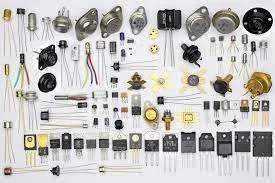
What is a Transistor?
A transistor is an electronic component used in circuits to control a large amount of current or voltage with a small amount of voltage or current. This means it can be used to amplify or switch (rectify) electrical signals or power, allowing it to be used in a wide variety of electronic devices.
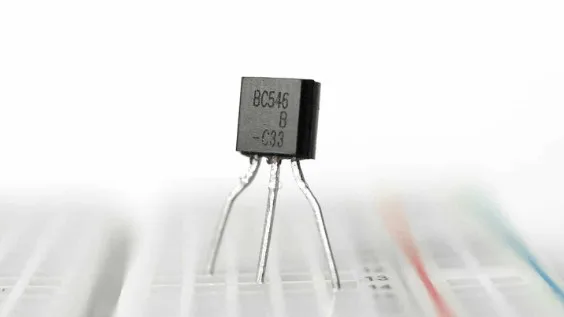
This is done by sandwiching one semiconductor between two other semiconductors. Because current is transferred across a material that normally has high resistance (that is, a resistor), this is a “transfer-resistor” or transistor.
The first practical point-contact transistor was built in 1948 by William Bradford Shockley, John Bardeen, and Walter House Brattain. A patent for the transistor concept existed as early as 1928 in Germany, although it seems it was never built, or at least no one claimed to have built it. The three physicists received the 1956 Nobel Prize in Physics for this work.
Basic Point-Contact Transistor Structure
Basically there are two basic types of point-contact transistors, the npn transistor and the pnp transistor, where n and p stand for negative and positive respectively. The only difference between the two is the bias voltage arrangement.
To understand how a transistor works, you must understand how semiconductors react to electric potential. Some semiconductors will be n-type, or negative, meaning that free electrons in the material drift from the negative electrode (from, say, a battery connected to it) toward the positive. Other semiconductors will be p-type, in which case electrons fill “holes” in the atoms' electron shells, meaning that it behaves as if positive particles move from the positive electrode to the negative electrode. The type is determined by the atomic structure of the particular semiconductor material.
Now, consider an npn transistor. Each end of the transistor is an n-type semiconductor material and between them is a p-type semiconductor material. If you imagine such a device plugged into a battery, you will see how the transistor works:
- the n-type region attached to the negative end of the battery helps push electrons into the p-type region in the middle.
- the n-type region attached to the positive end of the battery helps slow electrons leaving the p-type region.
- the p-type region in the middle does both.
By varying the potential in each region, you can drastically affect the rate of electron flow across the transistor.
Benefits of Transistors
Compared with the vacuum tubes used previously, the transistor was a tremendous advance. Being smaller, transistors can easily be mass-produced cheaply. Transistors also have many operational advantages that are too numerous to mention here.
Some people consider the transistor the single greatest invention of the 20th century because it opened many paths to other advances in electronics. Almost every modern electronic device has a transistor as one of its main active components. Because they are the building blocks of microchips, computers, telephones, and other devices would not exist without transistors.
Other Types of Transistors
Various types of transistors have been developed since 1948. The following is an example list of different types of transistors:
- Bipolar junction transistor (BJT)
- Field-effect transistor (FET)
- Heterojunction bipolar transistor
- Unijunction transistor
- Dual-gate FET
- Avalanche transistor
- Thin-film transistor
- Darlington transistor
- Ballistic transistor
- FinFET
- Floating gate transistor
- Inverted-T effect transistor
- Spin transistor
- Photo transistor
- Insulated gate bipolar transistor
- Single-electron transistor
- Nanofluidic transistor
- Trigate transistor (Intel prototype)
- Ion-sensitive FET
- Fast-reverse epitaxal diode FET (FREDFET)
- Electrolyte-Oxide-Semiconductor FET (EOSFET)
Well, that is more or less What a Transistor Is. Let's get to know our study program better Bachelor of Telecommunication Engineering and visit the official website Telkom University Jakarta Campus yes!
Written by Dzul Rahman
