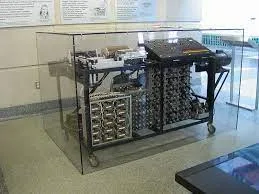
The Atanasoff-Berry Computer: The First Electronic Computer
John Atanasoff once told reporters, “I have always taken the position that there is enough credit for everyone in the invention and development of the electronic computer.”
Professor Atanasoff and graduate student Clifford Berry certainly deserve credit for building the world's first electronic digital computer at Iowa State University between 1939 and 1942. The Atanasoff-Berry Computer represented several innovations in computing, including a binary arithmetic system, parallel processing, regenerative memory, and the separation of memory and computing functions.
Atanasoff's Early Years
Atanasoff was born in October 1903, a few miles west of Hamilton, New York. His father, Ivan Atanasov, was a Bulgarian immigrant whose surname was changed to Atanasoff by an immigration officer at Ellis Island in 1889.
After John's birth, his father accepted an electrical engineering position in Florida, where Atanasoff completed elementary school and began to grasp concepts of electricity - he found and repaired a broken electrical wire in the back porch light at the age of nine - but aside from that event, his elementary school years passed smoothly.
He was a good student and had a keen interest in sports, especially baseball, but his interest in baseball faded when his father bought a new Dietzgen slide rule to help with his work. Young Atanasoff became deeply fascinated by the tool. His father soon realized he had no immediate need for the slide rule, and it was forgotten by everyone - except young John.
Atanasoff soon became interested in the study of logarithms and the mathematical principles behind the operation of the slide rule. This led him to the study of trigonometric functions. With his mother's help, he read A College Algebra by J.M. Taylor, a book that included an early study of differential calculus and a chapter on infinite series and how to compute logarithms.
Atanasoff finished high school in two years, excelling in science and mathematics. He had decided that he wanted to become a theoretical physicist and entered the University of Florida in 1921. The university did not offer a degree in theoretical physics, so he began taking electrical engineering courses. While taking these courses, he became interested in electronics and went on to higher mathematics. He graduated in 1925 with a Bachelor of Science degree in electrical engineering. He received a teaching fellowship from Iowa State College because of the institution's good reputation in engineering and science. Atanasoff received a master's degree in mathematics from Iowa State College in 1926.
After marrying and having a child, Atanasoff moved his family to Madison, Wisconsin, where he was accepted as a doctoral candidate at the University of Wisconsin. Working on his doctoral thesis, “The Dielectric Constant of Helium,” gave him his first experience of serious computation. He spent hours in front of a Monroe calculator, one of the most sophisticated calculating machines at the time. During weeks of calculations to complete his thesis, he became interested in developing a better and faster computing machine. After receiving his Ph.D. in theoretical physics in July 1930, he returned to Iowa State College determined to try to create a faster and better computing machine.
The First “Computing Machine”
Atanasoff became a faculty member of Iowa State College as an assistant professor of mathematics and physics in 1930. He felt he was well equipped to try to find a way to solve the complex mathematical problems he had encountered during his doctoral thesis in a faster and more efficient way. He experimented with vacuum tubes and radios and researched the field of electronics. He was then promoted to associate professor of mathematics and physics and moved into the school's Physics Building.
After examining many of the mathematical devices available at the time, Atanasoff concluded that they fell into two classes: analog and digital. The term “digital” was not used until some time later, so he compared analog devices with what he called “exact computing machines.” In 1936, he was involved in his last attempt to build a small analog calculator. Together with Glen Murphy, then an atomic physicist at Iowa State College, he built the “Laplaciometer,” a small analog calculator. The device was used to analyze surface geometry.
Atanasoff considered this machine to have the same weakness as other analog devices - accuracy depended on the performance of other parts of the machine. His obsession with finding a solution to the computer problem peaked in the winter months of 1937. One night, frustrated after many disappointing events, he got into his car and began driving aimlessly. Two hundred miles later, he stopped at a roadhouse. He drank bourbon and kept thinking about creating the machine. No longer nervous and tense, he realized that his thoughts were beginning to come together clearly. He began to generate ideas on how to build this computer.
The Atanasoff-Berry Computer
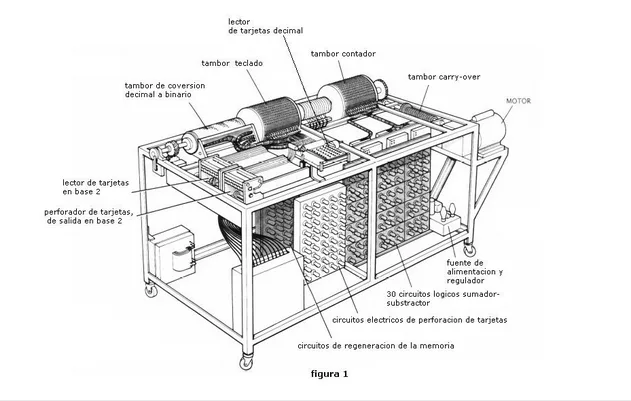
After receiving a $650 grant from Iowa State College in March 1939, Atanasoff was ready to build his computer. He hired a very bright electrical engineering student, Clifford E. Berry, to help him achieve his goal. With his background in electronics and mechanical construction skills, the brilliant and inventive Berry was an ideal partner for Atanasoff. They worked to develop and refine the ABC, or Atanasoff-Berry Computer, as it was later named, from 1939 to 1941.
The final product was the size of a desk, weighed 700 pounds, had more than 300 vacuum tubes, and contained a mile of wire. The computer could perform about one operation every 15 seconds. Today, a computer can perform 150 billion operations in 15 seconds. Because it was too large to carry around, the computer remained in the basement of the physics department.
World War II
World War II began in December 1941 and work on the computer came to a halt. Although Iowa State College had hired a Chicago patent attorney, Richard R. Trexler, the patenting of the ABC was never completed. The war effort prevented John Atanasoff from completing the patent process and doing further work on the computer.
Atanasoff left Iowa State on leave to take a defense-related position at the Naval Ordnance Laboratory in Washington, D.C. Clifford Berry took a defense-related job in California. On one of his visits back to Iowa State in 1948, Atanasoff was surprised and disappointed to learn that the ABC had been removed from the Physics Building and dismantled. Neither he nor Clifford Berry had been told that the computer would be destroyed. Only a few parts of the computer were saved.
The ENIAC Computer
Presper Eckert and John Mauchly were the first to receive a patent for a digital computing device, the ENIAC computer. The 1973 patent infringement case, Sperry Rand v. Honeywell, invalidated the ENIAC patent as derived from Atanasoff's invention. This was the source of Atanasoff's remark that there was enough credit for everyone in the field. Although Eckert and Mauchly received most of the credit for creating the first electronic digital computer, historians now say that the Atanasoff-Berry Computer was the first.
“It was then, one night while drinking scotch and driving at 100 mph,” John Atanasoff also told reporters, “that the concept came to me for an electronically operated machine that would use base-two binary numbers instead of the traditional base-10 numbers, condensers for memory, and a regenerative process to prevent memory loss due to power failure.”
Atanasoff wrote most of the concepts of the first modern computer on the back of a cocktail napkin. He loved fast cars and scotch. He died of a stroke in June 1995 at his home in Maryland.
And that, more or less, is the Atanasoff-Berry Computer: The First Electronic Computer. Get to know our study program better Bachelor of Telecommunication Engineering and visit the official website Telkom University Jakarta Campus yes!
Written by Dzul Rahman
