Understanding Big Data
Big data is data with volume, variety, and velocity that demands new technologies and new methodologies for collection, storage, analysis, and monetization
The most important aspect of big data is actually not just how much data can be stored and processed, but what use or added value can be obtained from that data. If we cannot get any value from it, the data will just be useless garbage. This added value can be used for many things, e.g., improving operations, sales accuracy, improving service quality, market forecasting or estimation, etc.
In informatics there is a term "Garbage in, Garbage out", meaning that garbage input will produce garbage output as well. That is, if the input we give to a system is of low quality, then the quality of the output will certainly be low too. The input referred to here is data.
Therefore, in implementing big data, it is necessary to ensure the quality of input and output at every processing stage to achieve high-quality final results.
Big Data Characteristics
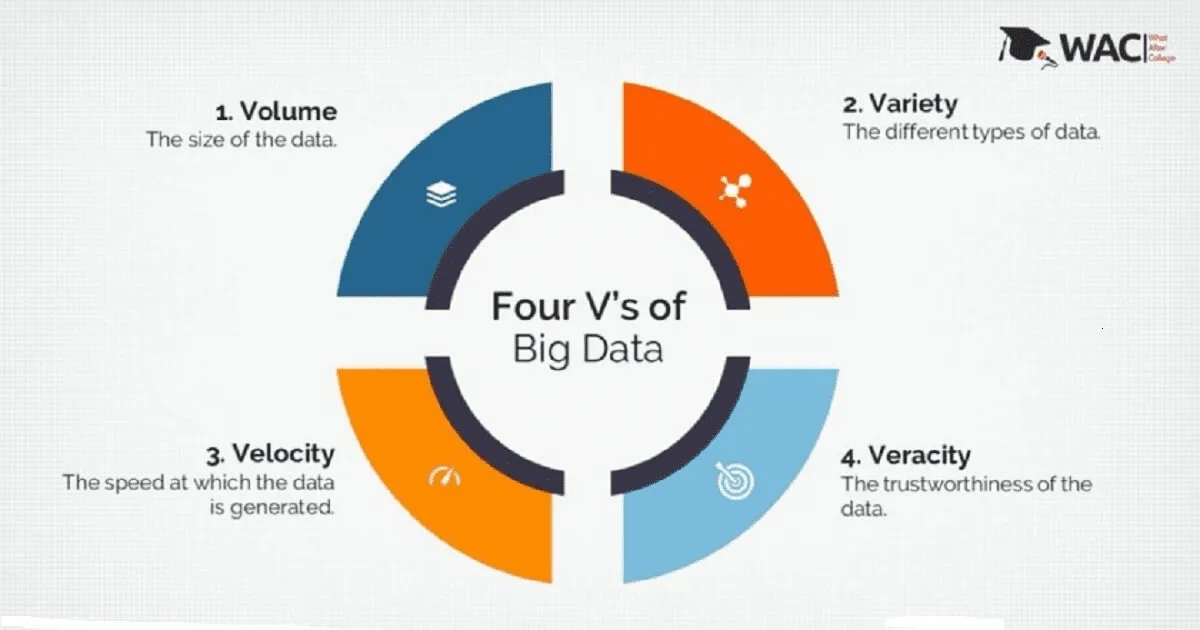
Big Data characteristics are commonly referred to by the acronym 4V, namely:
- Volume: refers to the size of the data that needs to be processed. Today the unit of data volume in the world has exceeded the zettabyte (1021 bytes). Many companies or organizations even need to process data up to petabytes per day.
- Velocity: is the speed at which data is generated. Data generated at high speed requires processing techniques different from ordinary transaction data. Examples of data generated at high speed are Twitter messages and data from machines or sensors.
- Variety: Big Data comes from various sources. It falls into one of three categories: structured, semi-structured, and unstructured data. These varied data types require special processing capabilities and algorithms. An example of highly varied data is social media data processing, which consists of text, images, sound, and video.
- Veracity: refers to the accuracy or consistency of data. Data with high accuracy will provide quality analysis results. Conversely, data with low accuracy contains a lot of bias, noise, and abnormalities. If this data is not processed properly, it will produce less useful output and can even give a misleading picture or conclusion. Veracity is a rather serious challenge in Big Data processing.
In addition to the 4Vs, some add one more, making it 5V, namely value. This value is often defined as the potential social or economic value that information can generate. The four characteristics above (volume, velocity, variety, and veracity) must be processed and analyzed to provide value or benefit in business and life. Therefore, the fifth characteristic is very closely related to our ability to process data to produce high-quality results.
Big data processing requires a different approach from traditional data processing. It requires special technologies and tools such as Hadoop, Spark, NoSQL databases, and cloud computing.
Implementation of Big Data in Business
Human habits and business competition in today's increasingly open era make making the right decisions the key to surviving in business. Data is one of the determinants of success in decision making.
Customer Profiling
Customer patterns and profiles can be seen from the data customers generate when interacting with a product, whether directly, through a website, or through an application. Today, customer profile data can be expanded further by including geographic data, and even the social media data they create.
The more information collected and the more sophisticated the data processing, the more accurate and detailed the customer profile information that can be obtained. Producers or service providers can give appropriate recommendations to customers to increase sales and customer loyalty.
Product Development
Building a product from an idea that is ultimately well accepted by the market is a challenge. Big data can provide deep insights
to identify market needs, see customer responses through comments on forums or social media, quickly evaluate product sales performance in the market, optimize the distribution chain, and optimize marketing strategies.
The better the data management and the faster data becomes available, the more sustainably products can continue to be created, providing good value for customers and users.
Price Optimization
Price can be the key for customers in deciding which product to buy. However, price wars can also have a bad effect on the product itself. Big data can provide maps and patterns of prices in the market, so producers can determine optimal prices and price promotions that fit market needs.
Here is a brief explanation of Big Data. Let's get to know the study program better Bachelor of Telecommunication Engineering and visit the official website ITTelkom Jakarta yes!
Written by Dzul Rahman
