
Sensor
Definition and Types of Sensors
A sensor is a device or instrument that detects and measures physical properties, environmental conditions, or changes in its surroundings, and converts this information into signals or data that can be interpreted, displayed, or recorded.
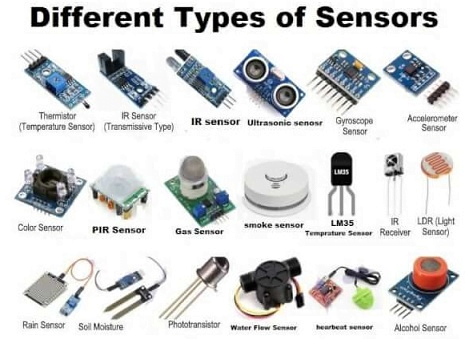
Types of Sensors
The following are some common types of sensors:
- Temperature Sensors:
- Thermocouple
- Thermistor
- Infrared sensor
- Pressure Sensors:
- Barometer
- Piezoelectric sensor
- Strain gauge
- Proximity Sensors:
- Infrared proximity sensor
- Ultrasonic sensor
- Capacitive sensor
- Motion Sensors:
- Accelerometer
- Gyroscope
- Magnetometer
- Light Sensors:
- Photodiode
- Phototransistor
- Light-dependent resistor (LDR)
- Sound Sensors:
- Microphone
- Piezoelectric sensor
- Gas Sensors:
- Carbon monoxide sensor
- Methane sensor
- Air quality sensor
- Humidity Sensors:
- Hygrometer
- Capacitive humidity sensor
- Resistive humidity sensor
- Image Sensors:
- Charge-Coupled Device (CCD) sensor
- Complementary Metal-Oxide-Semiconductor (CMOS) sensor
- Biometric Sensors:
- Fingerprint sensor
- Iris scanner
- Face recognition sensor
- Force Sensors:
- Strain gauge
- Piezoelectric sensor
- Flow Sensors:
- Turbine flow sensor
- Ultrasonic flow sensor
- Position Sensors:
- Potensiometer
- Hall effect sensor
- Encoder
- Radiation Sensors:
- Geiger-Muller counter
- Scintillation detector
- Vibration Sensors:
- Accelerometer
- Piezoelectric sensor
- Magnetic Sensors:
- Hall effect sensor
- Magnetoresistive sensor
- Touch Sensors:
- Resistive touchscreen
- Capacitive touchscreen
- IR (Infrared) Sensors:
- Infrared motion sensor
- Infrared thermometer
These sensors serve a variety of applications across industries such as automotive, healthcare, environmental monitoring, consumer electronics, and others. The choice of sensor depends on the specific requirements of the application and the type of data that needs to be collected.
Sensors in telecommunications are often used to detect, measure, or monitor certain conditions and parameters related to the telecommunication network or the devices involved, such as Network Performance Sensors.
Network performance sensors are devices or software systems designed to monitor, measure, and track various parameters that affect network performance. The main purpose of network performance sensors is to provide accurate, real-time information about network conditions, enabling active monitoring and effective management. The following are some parameters commonly monitored by network performance sensors:
- Latency (Delay): The time a data packet needs to travel from source to destination. Latency can be divided into several types, including transmission latency, processing latency, and queuing latency.
- Throughput: The amount of data that can be sent or received in a network in a given time. Throughput is often measured in bits per second (bps) or kilobits per second (Kbps) for small networks, and can reach megabits per second (Mbps) or gigabits per second (Gbps) for larger networks.
- Jitter: Variation in the delay time of data packet delivery in the network. Jitter can affect the quality of service for real-time applications such as video or VoIP (Voice over Internet Protocol) calls.
- Packet Loss: The percentage of data packets lost or not received during transmission. A high packet loss rate can degrade service quality.
- Network Utilization: The percentage of network capacity in use at a given time. It helps determine how heavily the network is utilized and whether capacity needs to be increased.
- Quality of Service (QoS): A parameter covering various aspects of network performance, including latency, jitter, and packet loss, taking into account the priorities and needs of specific applications.
- Congestion: An indication of when network demand exceeds its capacity, which can lead to increased latency and packet loss.
- Network Availability: The percentage of time the network is available for use. High availability is very important for critical networks that require continuous operation.
Network performance sensors can be used for continuous monitoring or during specific periods. The information collected by these sensors helps network administrators quickly identify, analyze, and respond to network performance problems to ensure optimal service.
