History of Computer Printers
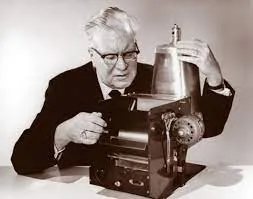
The history of computer printers began in 1938 when Seattle inventor Chester Carlson (1906-1968) invented a dry printing process called electrophotography – commonly called Xerox – which would become the basic technology for decades of laser printers to come.
Technology
In 1953, the first high-speed printer was developed by Remington-Rand for use on the Univac computer. The original laser printer, called EARS, was developed at the Xerox Palo Alto Research Center, beginning in 1969 and completed in November 1971. Xerox engineer Gary Starkweather (born 1938) adapted Carlson's Xerox copier technology by adding a laser beam to produce a laser printer.
According to Xerox Corporation, “The Xerox 9700 Electronic Printing System, the first xerographic laser printer product, was released in 1977. The 9700, a direct descendant of the original PARC “EARS” printer that pioneered laser scanning optics, character generation electronics, and page formatting software, was the first product on the market enabled by PARC research.”
Computing Printers
According to IBM, “The first IBM 3800 was installed in the accounting headquarters at the F. W. Woolworth data center in North America in Milwaukee, Wisconsin in 1976.” The IBM 3800 Printing System was the first high-speed laser printer in the industry. It was a laser printer that operated at speeds of more than 100 prints per minute. It was the first printer to combine laser and electrophotographic technology.
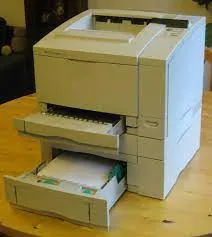
In 1976, the inkjet printer was invented, but it was not until 1988 that inkjet became a home consumer product with the release of the DeskJet inkjet printer by Hewlett-Packard, priced at $1000. In 1992, Hewlett-Packard released the popular LaserJet 4, the first 600 x 600 dots-per-inch resolution laser printer.
History of Printing
Printing, of course, is much older than computers. The oldest known printed book is the “Diamond Sutra,” printed in China in 868 AD. However, it is suspected that book printing may have occurred long before that date.
Before Johannes Gutenberg (circa 1400-1468), printing was limited in the number of editions made and was almost exclusively decorative, used for pictures and designs. The material to be printed was carved into wood, stone, and metal, rolled with ink or paint, and transferred by pressure onto parchment or vellum. Books were copied by hand, mostly by members of religious orders.
Gutenberg was a German craftsman and inventor, and he is famous for the Gutenberg printing press, an innovative press that used movable type. This machine remained the standard until the 20th century. Gutenberg made printing cheap.
Linotype and Typefaces
The invention of the linotype, made by German-born Ottmar Mergenthaler (1854-1899) in 1886, is considered the greatest advance in the printing world since Gutenberg's development of movable type 400 years earlier, allowing people to quickly set and break up entire lines of text.
In 1907, Samuel Simon of Manchester, England was granted a patent for the process of using silk cloth as a printing screen. Using materials other than silk for screen printing has a long history that began with the ancient art of stencils used by the Egyptians and Greeks as early as 2500 BC.
Walter W. Morey of East Orange, New Jersey, created the idea of the teletypesetter, a device for setting type by telegraph using coded paper tape. He demonstrated his invention in 1928, and Frank E. Gannett (1876-1957) of the Gannett newspapers supported the process and helped develop it.
The earliest phototypesetting machine was patented in 1925 by Massachusetts inventor R.J. Smothers. In the early 1940s, Louis Marius Moyroud (1914-2010) and Rene Alphonse Higonnet (1902-1983) developed the first practical phototypesetting machine. Their phototypesetter used a spotlight and a series of optics to project characters from a rotating disk onto photographic paper.
And that, more or less, is the History of Computer Printers. Get to know our study program better Bachelor of Telecommunication Engineering and visit the official website Telkom University Jakarta Campus yes!
Written by Dzul Rahman
