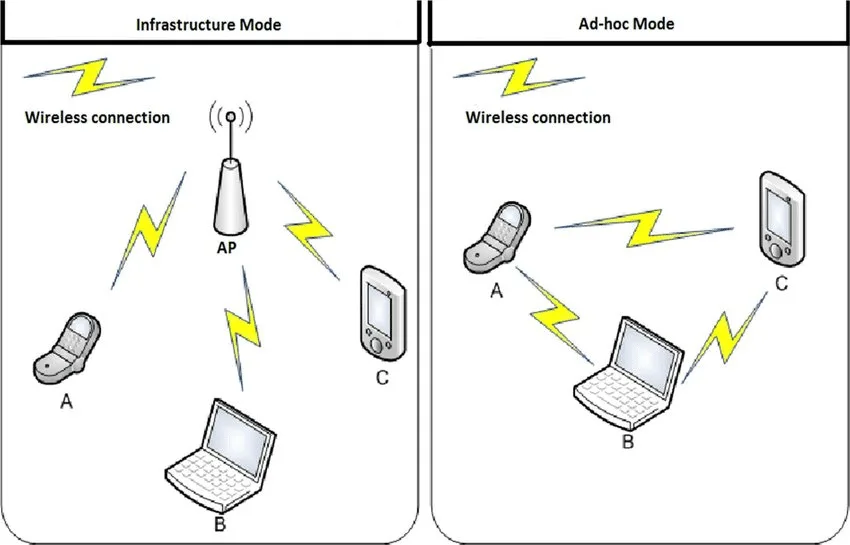
AD-HOC Network
An AD-HOC Network is dynamic. Besides being able to send and receive information, an ad hoc network can also support the use of the network as a router. There are many ways to connect devices together. This can be done through a wired or wireless network. Today, wireless networks are generally preferred. One wireless network you can try to connect your device to others is an Ad Hoc network. This article invites you to explore ad hoc networks in more detail. Below is information about the description of Ad Hoc networks, their features, and the advantages and disadvantages to be aware of.
Definition of AD-HOC Network
An ad hoc network is a type of wireless computer network that connects two or more devices so they can communicate with each other. In practice, however, ad hoc networks are often used to connect two devices, such as laptops, for data transfer. An ad hoc network consists of a number of nodes connected directly to each other without intermediaries such as a BTS. The nodes of an ad hoc network are dynamic. Therefore, an ad hoc network can not only send and receive information but also support the use of the network as a router.
Characteristics of AD-HOC Network
Because it can function like a router, , the Ad Hoc network requires a routing protocol to support the process of sending and receiving between node. In addition, the Ad Hoc also has several distinctive features. The explanation is as follows:
1. Limited Resources
Because an AD-HOC network is a network wireless, so the network is limited by power and memory capacity constraints.
2. Dynamic Topology
As mentioned earlier, AD-HOC networks are dynamic/changeable. Therefore, routing protocol has more complex problems than wired networks, which have a node fixed one.
3. Multiple Wireless Link
Nodes in AD-HOC networks there is the characteristic of mobility so there are several interface connected to node others.
Types of Ad Hoc Networks
You should know that AD-HOC networks come in several types. There are 7 types of Ad Hoc networks that can be used. The seven networks are:
1. Wireless Ad Hoc Network (WANET)
A Ad Hoc network found within the wireless network on computer devices and laptops. The way WANET works is almost the same as client and server where computer devices can send, receive, and generate data. Network connectivity greatly affects the distribution of node.
2. Mobile Ad Hoc Network (MANET)
A Ad Hoc network used on devices mobile such as mobile phones. MANET can connect freely in all directions. Therefore, its distribution often changes and is forwarded to unrelated network traffic.
3. Vehicular Ad Hoc Network (VANET)
A Ad Hoc that works from a vehicle and functions as a means of communication between vehicles or between vehicles and roadside units.
4. Internet Based Mobile Ad Hoc Network (iMANET)
A Ad Hoc that bridges mobile nodes with internet nodes, through a gateway. Its application can be seen in the infrastructure networks of a region or city.
5. Self Powered Ad Hoc Network (SPAN)
A Ad Hoc whose operating costs are relatively low. A SPAN network takes advantage of technological advances in permanent energy power management. In addition, there are microsensor and processing technologies optimized for users who need rapid information dissemination. The application of SPAN is usually used in war exercises.
6. Military Networks (Tactical MANETs)
MANETs are also used for military purposes to determine the location of each soldier. A MANETs focused on security, coverage, and network integration with existing systems in the military field.
7. Smart Phone Ad Hoc Network (SPANs)
A Ad Hoc that use bluetooth and wifi to build a network peer to peer. This network does not depend on cellular operators, wireless access points, or traditional network infrastructure.
Advantages and Disadvantages of Ad Hoc Networks
Ad hoc networks are widely used because they have several advantages. They are considered convenient because they do not need cables for transmission. The cost is also relatively low because only one wireless device is used on one laptop. In addition, they are easy to use for sharing files and configuration. Unfortunately, the number of networks that can be connected is limited. In addition, the data transfer process takes quite a long time.
Here is an explanation of AD-HOC Networks. Get to know our study program better Bachelor of Telecommunication Engineering and visit the official website Telkom University Jakarta Campus yes!
Written by Dzul Rahman
