Gigabit Capable Passive Optical Network (GPON)
Gigabit Capable Passive Optical Network (GPON) is an access node technology required to deliver multimedia services (voice, data, video, and other content) to residential and business customers. GPON was first proposed by the FSAN organization in September 2002.
GPON technology is the latest generation of broadband optical integrated access standards based on the ITU-T G.984.x standard. It has many advantages such as high bandwidth, high efficiency, large coverage, rich user interfaces, etc. Most operators regard it as the ideal technology for achieving broadband and integrated transformation of access network services.
Gigabit Capable Passive Optical Network (GPON) Standard
GPON was first proposed by the FSAN organization in September 2002. On this basis, ITU-T completed the development of ITU-T G.984.1 and G.984.2 in March 2003, and completed the standardization of G.984.3 in February and June 2004. Thus, the GPON family of standards was finally formed.
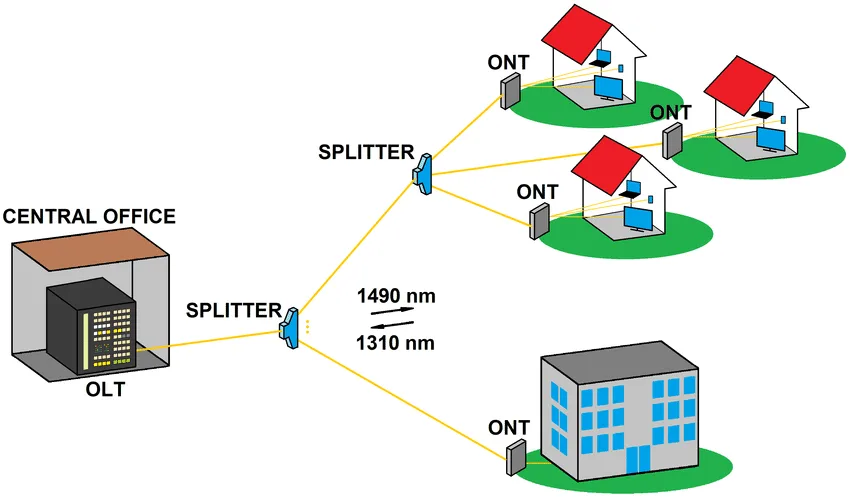
The basic structure of devices based on GPON technology is similar to existing PON. It also consists of an OLT (optical line terminal) at the central office and an ONT / ONU (optical network terminal or optical network unit) at the user end; the first two devices are connected by single-mode optical fiber (SM fiber) and passive splitters, which together form the ODN (Optical Distribution Network), plus a network management system.
Compared with other PON standards, the GPON standard provides unprecedented high bandwidth with a downlink rate of up to 2.5 Gbit/s, and its asymmetric characteristics are better suited to the broadband data service market. It provides full QoS service guarantees and carries ATM cells and/or GEM frames. It offers a good service level, QoS guarantees, and full service access. When carrying GEM frames, TDM services can be mapped into GEM frames, and the standard 8 kHz (125 μs) frame can directly support TDM services. As a carrier-grade technical standard, GPON also specifies protection mechanisms and completes the OAM functions at the access network level.
In the GPON standard, the types of services that need to be supported are clearly defined: data services (Ethernet services, including IP services and MPEG video streams), PSTN services (POTS, ISDN services), leased lines (T1, E1, DS3, E3, and ATM services), and video services (digital video). Multiple services in GPON are mapped into ATM cells or GEM frames for transmission, providing appropriate QoS guarantees for the different service types.
Gigabit Capable Passive Optical Network (GPON) Network Modes
Currently, the main network modes adopted by GPON are FTTH / O, FTTB + LAN, and FTTB + DSL.
1) FTTH / O is fiber to the home / office. After the optical fiber enters the optical splitter, it connects directly to the user's ONU. The ONU is used by only one user. Bandwidth is high and so is the cost. In general, this is aimed at high-end users and commercial users.
2) FTTB + LAN is fiber-to-the-floor, which then provides several services to many users through a high-capacity ONU (called an MDU). Therefore, many users share the bandwidth resources of a single ONU, each occupying less bandwidth at a lower cost, generally for high-end and mid-range business users.
3) FTTB + ADSL is fiber-to-the-building, which then serves many users in ADSL mode. It also shares several ONUs among multiple users. Bandwidth, cost, and customer base are similar to FTTB + LAN.
GPON Standard
GPON is an ITU-T standard:
- G.984.1: Gigabit-capable passive optical networks (GPON): General characteristics
- G.984.2: Gigabit-capable Passive Optical Networks (GPON): Physical Media Dependent (PMD) layer specification
- G.984.3: A broadband optical access system with increased service capability by wavelength allocation
- G.984.4: Gigabit-capable Passive Optical Networks (GPON): ONT management and control interface specification
GPON Architecture
The GPON architecture consists of:[2]
- Optical Line Termination (OLT)
- Optical Distribution Network (ODN)
- Optical Network Unit (ONU) or Optical Network Terminal (ONT)
Optical Line Termination (OLT)
- A device that serves as the end point, namely the root of an ODN,
- implements the PON protocol, as defined by [ITU-T G.984].
- adapts the PON PDU for the service interface toward the Service Provider. The OLT provides management and maintenance functions for the subtended ODN and ONUs.
Optical Distribution Network (ODN)
- A tree topology of optical fiber in the access network,
- equipped with a power splitter or wavelength splitter, filters, or other passive optical devices.
Optical Network Unit (ONU)
- a general term for a device that terminates one of the endpoints distributed by the ODN,
- implements the PON (Passive Optical Network) protocol,
- adapts the PON PDU (Protocol Data Unit) for the service interface toward the customer.
- In some contexts, an ONU implies multiple customer devices.
Optical Network Termination
- A single customer device as the end point, namely as a leaf of the ODN distribution, implementing the PON protocol,
- adapting the PON PDU for the service interface toward the customer.
- An ONT is a special case of an ONU.
Physical GPON
Physical GPON follows the ITU-T G.984.2 standard,[3]
- The transmission medium is fiber optic based on the ITU-T G.652 standard
- Transmission method: Bidirectional transmission using wavelength division multiplexing (WDM) on a single fiber, or unidirectional transmission over two fibers.
- The downstream bit rate (OLT to ONU) is 1244.16 or 2488.32 Mbps and the upstream bit rate (from ONU to OLT) is 155.52, 622.08, 1244.16, or 2488.32 Mbps.
- Line code: Downstream and upstream: NRZ coding. The scrambling method is not defined at the PMD layer. The optical logic level rules are: high light emission level for binary ONE; low light emission level for binary ZERO.
- Wavelength: downstream direction: single fiber: 1480 – 1500 nm, two fibers: 1260 – 1360 nm, and upstream direction: 1260-1360
Well, the following is more or less the explanation of Gigabit Capable Passive Optical Network (GPON). Let's get to know our study program better Bachelor of Telecommunication Engineering and visit the official website Telkom University Jakarta Campus yes!
Written by Dzul Rahman
