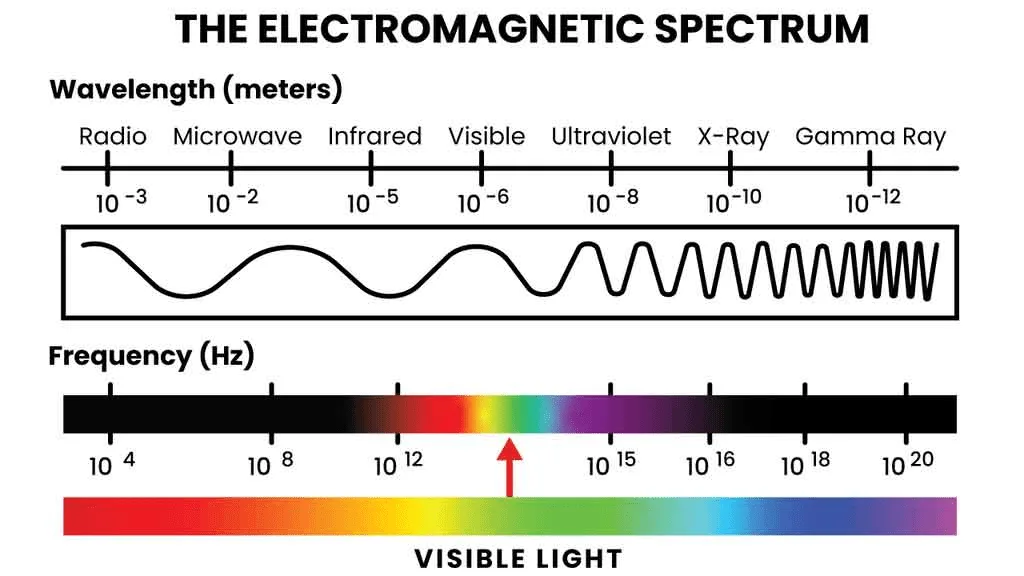
Electromagnetic spectrum
The electromagnetic spectrum is the range of frequencies of electromagnetic waves across all electromagnetic radiation. The electromagnetic spectrum is observed in radio signals, television signals, radar signals, invisible light, X-rays, and gamma rays traveling at the speed of light.
The electromagnetic spectrum can be described in terms of wavelength, frequency, or energy per photon. It is directly related by wavelength multiplied by frequency giving the speed of light, 300 Mm/s (300 MmHz), the energy of a photon being 4.1 feV per Hz, i.e. 4.1 μeV/GHz, and wavelength multiplied by energy per photon being 1.24 μeVm
The electromagnetic spectrum can be divided into several regions ranging from gamma rays, short high-energy waves, to microwaves and very-long-wavelength radio waves. This division is actually not very strict and grew out of practical use that historically originated from various detection methods.
Typically, when describing the energy of the electromagnetic spectrum, it is expressed in electronvolts for high-energy photons (above 100 eV), in wavelength for medium energy, and in frequency for low energy (λ ≥ 0.5 mm). The term “optical spectrum” is also still widely used to refer to the electromagnetic spectrum, although it actually covers only part of the wavelength range (320 – 700 nm).
Examples of Electromagnetic Spectrum Waves
In everyday life, the following are some electromagnetic spectra:
1. Radio Waves
Electromagnetic waves in radio are relatively long and have a low frequency range. The wavelength of radio waves is between 0.3 – 600 meters with a frequency range of about 5×10^5 Hertz to 10^9 Hertz. Radio waves are divided into several bands based on frequency. The shortwave band is at 500 kHz – 54 MHz. Within it is the AM radio band, with frequencies of 530 kHz – 1710 kHz.
2. Microwaves
Microwaves have a shorter wavelength and a higher frequency than radio waves. Microwaves are produced by high-power vacuum tubes and by semiconductor devices such as field-effect transistors, Gunn diodes, tunnel diodes, and others. The frequency of microwaves ranges from 109 Hertz to 3×10¹¹ Hertz, while their wavelength ranges from 10-3 meters to 0.3 meters. Microwaves can be seen at work in a microwave oven.
3. Infrared Rays
Infrared waves have a shorter wavelength and a higher frequency than microwaves. Infrared rays are known as heat waves, with wavelengths ranging from 8×10⁻⁷ meters to 10-3 meters and frequencies from 3×10¹¹ Hertz to 4×10¹⁴ Hertz. Thermal radiation emitted by all hot objects is the main source of infrared radiation. The atoms and molecules in a heated object gain thermal energy and vibrate with greater amplitude.
4. Ultraviolet Rays
These electromagnetic rays have wavelengths between 380 nm – 10 nm. Their frequency ranges from 8×10¹⁴ Hertz – 3×10¹⁶ Hertz. This radiation is known as ultraviolet because its frequency is higher than that of violet light. Ultraviolet rays are widely used in daily life, for example to kill germs in water purification, in LASIK eye surgery, and in UV lamps.
5. Gamma Rays
Gamma rays are the next type of electromagnetic wave, with the shortest wavelength and the highest frequency of all electromagnetic waves. Their wavelength ranges from 0.6×10⁻¹⁴ meters to 10-10 meters, while their frequency lies between 3×10⁸ Hertz and 5×10²² Hertz. Gamma rays come from nuclear radioactivity and nuclear reactions. They are also widely used in radiotherapy to treat cancer and tumors. Waves of the electromagnetic spectrum are encountered in everyday life, such as radio, microwaves, smartphone signals, and more. These electromagnetic waves do not need a propagation medium and have both electric and magnetic components.
Physical properties
Electromagnetic waves are usually defined using the physical properties of frequency f, wavelength λ, or photon energy E. Wavelength is inversely proportional to frequency; for example, gamma rays have a wavelength smaller than an atom but a very high frequency. Meanwhile, photon energy is directly proportional to wave frequency. The relationships above can be expressed as the following equations:

where:
- c = 299,792,458 m/s, or the speed of light in a vacuum
- h = 6,62607055×10⁻³⁴ J·s is Planck's constant.
When an electromagnetic wave travels through a certain medium or material, its wavelength becomes shorter.
Spectroscopy can detect the electromagnetic spectrum over a range greater than that of human vision. Detailed information about the physical properties of an object, a gas, or even a star can be obtained with this device. Spectroscopes are very commonly used in astrophysics to study the composition of objects in the sky.
So, that is roughly what the electromagnetic spectrum is. Let's get to know the study program better: Bachelor of Telecommunication Engineering and visit the official website Telkom University Jakarta Campus yes!
Written by Dzul Rahman
