What Is a Drive Test
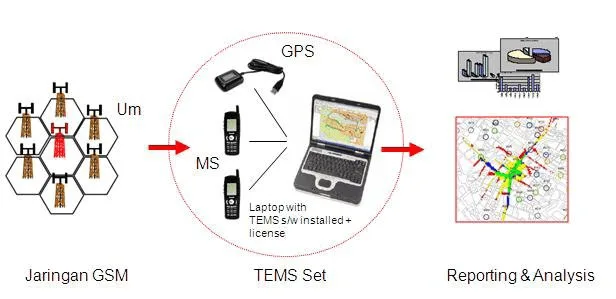
Drive Test is the process of measuring a mobile telecommunication system on the radio-wave side over the air, that is, from the transmitter/BTS to the MS/mobile phone or vice versa, using a mobile phone specially designed for measurement. The image above shows the equipment needed for drive testing, which is a Mobile Station (MS) connected to a laptop; a vehicle such as a car is also usually needed to drive to the target area so that drive testing can proceed faster.
Drive Test Engineer is a person who checks signals through drive testing or walk testing to collect data. The data will then be analyzed to determine the signal quality in the area.
Drive test activities allow operators such as Telkomsel, Indosat, XL, Smartfren, and H3i to carry out optimization to improve network quality. In addition, drive testing can also simulate errors that may occur on the customer side.
For example, if a customer's call drops while using a phone inside a moving object at a certain location, the drive test equipment must be able to simulate this problem. Other problems that can be detected through drive testing are blocked calls (failure to gain access), poor voice quality, and poor service area coverage.
Therefore, measuring signal quality is very important. This activity helps in taking measurements, storing data on a computer, and displaying data by time and transmitter location, which makes data processing for analysis easier.
Data obtained from a drive test
The following data are obtained:
- Knowing which BTS serves the MS, determined from the pilot of the BTS sector that handles it.
- Observing signal level (Rx_lev), signal quality (Ec/Io), the distance between the BTS antenna and the MS during measurement, Tx power, Forward/Reverse FER as a % of call quality, the percentage of dropped calls, active set, candidate set, finger information, the number of calls made, the percentage of failed calls, and total calls.
- Contains information about the site serving the MS and the surrounding sites with the strongest pilot signals that are candidates for handoff.
Conditions for conducting a drive test
The following are some examples of conditions for conducting a good drive test:
- Drive test initial, carried out when a BTS has just been installed to obtain its baseline data and to show how viable the network is.
- Drive test maintaining, carried out to monitor BTS performance according to a predetermined schedule.
- Carried out when truly necessary, namely when there are customer complaints or a drop in BTS performance seen in the daily reports.
Display results of the measurements
There are two kinds of display results produced by the measurements:
- Statistical mode that is, measurement results presented as overall statistics, so the exact location of the problem area cannot be determined.
- Trace mode that is, the drive test results can be viewed as a map showing plots of the routes traveled during the drive test. The color indications on the map therefore reveal the areas with problems.
Types of drive test measurements
The following are some examples of measurement types:
- Idle Mode is a measurement of the signal quality received by the MS while idle (not making a call or sending an SMS). This mode is usually used only to find the signal strength of an area indicated as having low signal or no service.
- Dedicated Mode is a measurement of signal quality accompanied by channel occupation (a long call or short call to a specific destination number), used to measure and identify voice and data quality.
- QoS Mode is a measurement of signal quality accompanied by channel occupation using call set up and call end methods with a specific time formula or command sequence.
So, that is roughly the explanation of Drive Testing. Let's get to know the study program better: Bachelor of Telecommunication Engineering and visit the official website Telkom University Jakarta Campus yes!
Written by Dzul Rahman
